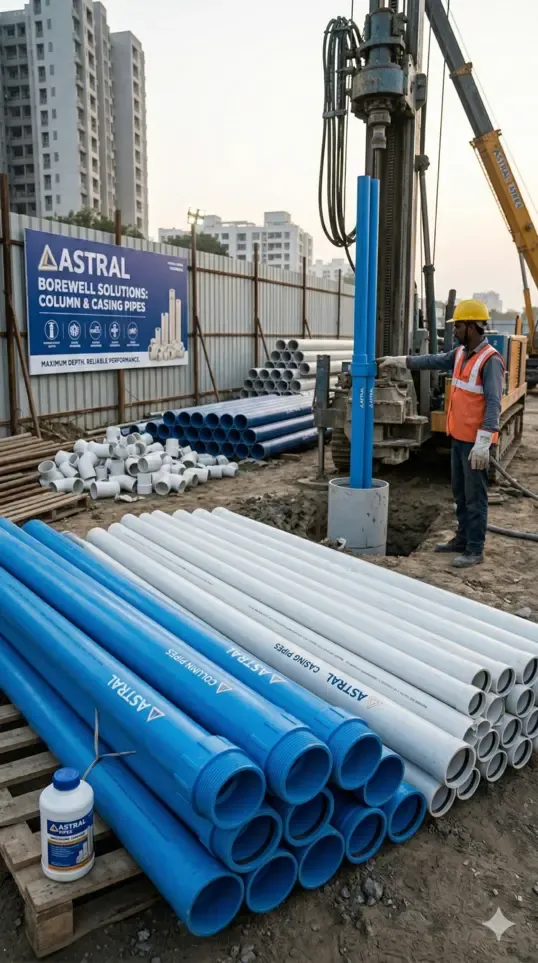
In the world of deep borewell infrastructure across Gujarat and Rajasthan, the choice of column pipe is not a procurement decision — it is a structural engineering commitment. A column pipe carries not merely water, but the full suspended weight of the submersible pump assembly, the entrained water column, and must withstand the lateral stresses of soil movement at depths exceeding 200 meters. Choosing incorrectly is not a risk; it is a guarantee of failure.
Astral Poly Technik's UPVC column pipe range has become the preferred specification for authorized industrial dealers like Xanausun for a precise set of engineering reasons — reasons rooted in material science, threading geometry, and long-term chemical resistance.
"The column pipe is the load-bearing spine of your entire borewell system. It doesn't pump water — it holds everything together under conditions that would collapse standard PVC within two monsoon cycles."
Material Composition: Why UPVC Over Standard PVC
Unplasticized Polyvinyl Chloride (UPVC) is chemically identical to PVC at its base but processed without the addition of plasticizers — the chemical agents that make standard PVC flexible. This absence makes UPVC significantly harder, more rigid, and critically, far more resistant to creep deformation under sustained load. In a deep borewell, where a pipe must carry 40–80 kg of suspended pump equipment plus the hydraulic pressure of a water column at depth, creep resistance is non-negotiable.
Astral's column pipe formulation uses a proprietary impact modifier ratio that raises notched impact strength to 8 kJ/m² while maintaining a Vicat softening point above 80°C — critical for installations in Gujarat where borewell water temperatures can exceed 45°C in shallow aquifers.
Threading Standards: Square Thread vs. Standard NPT
The most critical engineering detail in column pipe selection is the thread profile. Astral specifies square-form threads (also called Acme threads) on their column pipe range, explicitly because square threads have a near-zero radial force component during axial loading. Compare this to standard NPT (tapered pipe threads), which generate a significant wedging force under axial tension — force that progressively loosens the connection at depth as pump vibration accumulates over months of operation.
- Square thread mechanical advantage: Transmits axial loads with 50% less thread stress than V-profile or NPT alternatives
- Self-locking geometry: At a helix angle below the friction angle, square threads cannot back-rotate under vibration — eliminating progressive joint loosening
- Extraction compatibility: Easier to disassemble for pump retrieval after 5–8 years without thread galling, preserving the pipe for reuse
- Anti-torque design: Prevents the pipe string from rotating when the motor starts, which would otherwise unscrew lower joints in deep installations
Pressure & Load Specifications
Astral column pipes are manufactured in Class 4, Class 6, and Class 10 pressure ratings. For deep borewell applications, Class 6 and Class 10 are standard depending on depth and pump horsepower.
| Specification | Class 4 | Class 6 | Class 10 |
|---|
| Working Pressure (bar) | 4.0 | 6.0 | 10.0 |
| Wall Thickness (40mm OD) | 1.8mm | 2.6mm | 4.1mm |
| Recommended Max Depth | 80m | 150m | 250m+ |
| Suitable HP Range | Up to 3HP | 3–15HP | 15–50HP |
Chemical Resistance in Saline & Alkaline Water
Gujarat's groundwater chemistry is notoriously aggressive. TDS levels in coastal aquifers near Saurashtra regularly exceed 3,000 mg/L, with elevated chloride and sulphate concentrations. Astral's UPVC formulation is inherently non-reactive to these ions — unlike galvanized steel or mild steel column pipes, which develop internal scale and external corrosion within 18–24 months under equivalent conditions.
Xanausun specifically mandates UPVC column pipes over GI alternatives for any borewell with tested TDS above 800 mg/L. The long-term cost differential, when accounting for GI pipe replacement cycles, consistently favors UPVC by a factor of 2.5–3x over a 10-year horizon.
Installation Best Practices
- PTFE tape on all threads: Apply two full clockwise wraps of PTFE on male threads before assembly. Never use pipe dope or liquid sealants, which can degrade UPVC over time.
- Torque control during assembly: Hand-tighten plus 1.5 turns maximum. Over-torquing square threads causes longitudinal cracking of the pipe collar — a failure mode that typically presents at 60–80 meters depth, where recovery is extremely costly.
- Casing alignment: Ensure borewell casing diameter exceeds column pipe OD by minimum 50mm for free-flow annulus, preventing hydraulic binding during pump extraction.
- Support rope: Always run a stainless-steel safety rope alongside the column pipe for pump installations exceeding 100m. This provides a mechanical failsafe if the column string parts at a joint.
CONSULTATIONNEED ASTRAL COLUMN PIPES FOR YOUR PROJECT?
GET WHOLESALE PRICING