Ahmedabad sits on the banks of the Sabarmati River. Historically, during the punishing summer months when the river ran dry, the city faced severe water scarcity. The development of Ahmedabad into arguably India's foremost textile and manufacturing hub in the 20th century was not just built on cotton and entrepreneurial grit—it was built on deep earth water extraction.
Today, practically every high-rise, chemical plant, diamond polishing unit, and residential colony relies heavily on deep borewells (tubewells). How did this arid landscape learn to tap into subterranean oceans 1,500 feet below the surface? Let's explore the mechanical history and engineering principles of Ahmedabad's borewells.
The Evolution of Drilling in Gujarat
1. The Hand-Dug Era & The Stepwells
For centuries, Gujarat relied on shallow groundwater extraction. Elaborate architectural masterpieces like the Adalaj Stepwell (Vav) were built to reach the fluctuating water table. However, these were entirely dependent on seasonal monsoons and rarely reached deeper than 100 feet. They could not sustain industrial factories.
2. The Introduction of Rotary Drilling
In the mid-20th century, as the "Manchester of the East" industrialized, the demand for millions of liters of water per day exploded. Hand-digging was impossible.
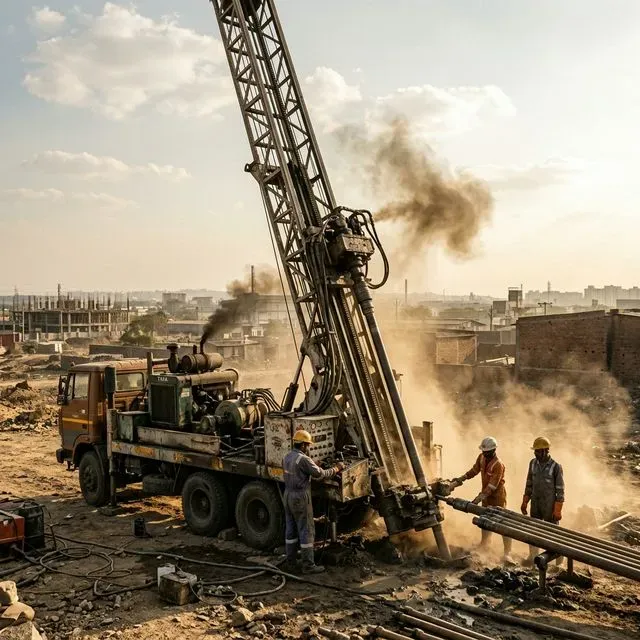
The state saw the introduction of massive truck-mounted rotary drilling rigs. These powerful diesel-engine monoliths changed everything. Instead of digging a massive hole, a rotary rig spins a heavily tempered steel or diamond-studded drill bit down into the earth, grinding rock into dust, while simultaneously pumping high-pressure mud fluid down the hole to flush the debris out.
3. Conquering the Deep Aquifers
Ahmedabad’s hydrogeology is complex. Below the sandy topsoil lies dense, alluvial formations interspersed with hard rock. Early borewells stopped at 200 feet. Today, modern rigs routinely punch through bedrock up to depths of 800 to 1,500 feet, accessing pristine, millennia-old deep "confined aquifers" that remain immune to surface evaporation.
How a Modern Ahmedabad Borewell Works
If you walk past an active construction site in Odhav, Naroda, or SG Highway today, you are likely to see a drilling rig at work. Here is the exact technical process:
Phase 1: The Drilling
A heavy truck positions itself. The mast rises vertically. The rotary drill begins chewing through the earth. As it descends, 10-foot and 20-foot sections of heavy MS (Mild Steel) drill pipes are continuously threaded on.
Phase 2: Casing the Well
Once the target aquifer is struck, the drill string is extracted. Instantly, the hole is at risk of collapsing. Engineers immediately drop Casing Pipes down the entire length of the hole. Decades ago, these were always Mild Steel (MS). Today, most residential projects use heavy-wall UPVC casing pipes because they do not rust in the heavily mineralized groundwater of Gujarat.
- The Slotted Pipes: Not all casing pipes are solid. Sections installed directly adjacent to the aquifer are "slotted" (cut with horizontal lines). This allows the pressurized groundwater to seep inside the casing pipe while keeping the sand and gravel out.
Phase 3: The Submersible Pump Drop
With the casing in place, the water level stabilizes inside the pipe. Now, a multi-stage submersible pump (often Indian legacy brands like Kirloskar, Varuna, or premium KSB units) is lowered into the well, attached to a heavy-duty discharge pipe (Column pipe) and thickly insulated waterproof electrical cables.
Phase 4: Pressurization
The control panel (increasingly equipped with VFDs) is fired up. The electrical current spins the pump's impellers at 2900 RPM. The centrifugal force throws the water upward through the column pipe, delivering thousands of liters per hour to surface storage tanks.
The Future of Groundwater Management
Ahmedabad's reliance on borewells has created modern challenges. Unregulated pumping has led to declining water tables and increased Total Dissolved Solids (TDS). The future of Ahmedabad’s fluid engineering is shifting toward managed aquifer recharge—routing filtered monsoon rainwater directly back down into these very same borewells to replenish the subterranean reserves for future generations.
At Xanausun, we respect this history. As Ahmedabad's premier industrial trading outfit, providing the casing pipes, submersible pumps, and VFD panels that power this city's water infrastructure is a legacy we proudly continue.