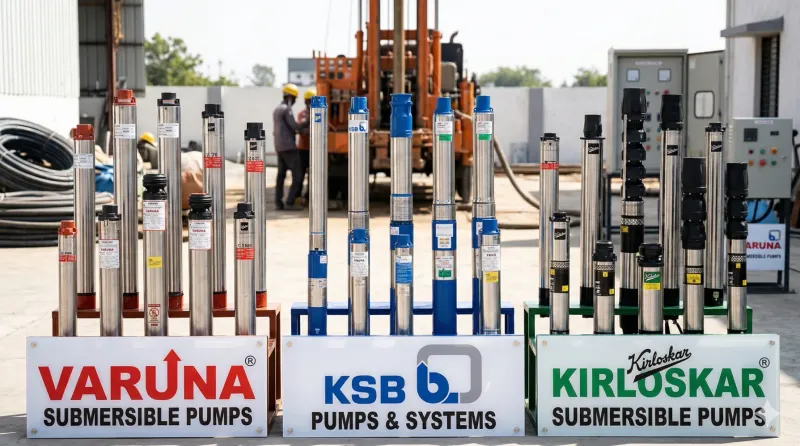
Kirloskar Brothers Limited has manufactured centrifugal pumping equipment in India since 1888. Over 130 years later, their submersible pump range remains the most widely specified in Gujarat's industrial and agricultural sectors — a loyalty earned not from marketing, but from mean time between failures that consistently outperforms imported alternatives by 15–30% across equivalent HP classes. Understanding the technical basis behind Kirloskar pump selection is essential to extracting this performance reliably over a 10–15 year operational cycle.
At Xanausun, as an authorized Kirloskar dealer, we specify the correct model not by HP alone, but by the convergence of three parameters: total dynamic head (TDH), required flow rate (LPM), and borewell casing diameter. Getting any one of these wrong results in a pump operating outside its best efficiency point — leading to premature motor winding failure, excessive power consumption, or hydraulic vibration damage to the column pipe string.
"The most common mistake in pump selection is treating HP as the primary specification. HP is an output. The real inputs are head and flow. HP is simply what results when you supply those correctly."
Understanding the KS Series Range
Kirloskar's borewell submersible pumps are organized primarily by casing diameter — the KS4 series for 4-inch borewells, KS6 for 6-inch, and KS8 for 8-inch industrial casings. Each diameter range spans from fractional HP domestic units to high-capacity industrial motors:
| Series | Casing | HP Range | Max Head | Max Flow (LPM) |
|---|
| KS4 (Domestic) | 4" | 0.5 – 3.0 HP | 110m | 250 |
| KS6 (Commercial) | 6" | 3.0 – 15.0 HP | 240m | 1,200 |
| KS8 (Industrial) | 8" | 15.0 – 50.0 HP | 320m | 4,500 |
| KST (Multistage) | 6"/8" | 5.0 – 40.0 HP | 450m | 2,800 |
Reading the Performance Curve: The Most Critical Skill
Every Kirloskar submersible pump ships with a certified performance (H-Q) curve — a graph plotting discharge head (meters) against flow rate (LPM) at the rated motor speed. The pump must operate within the shaded "preferred operating range" band on this curve, typically between 70% and 120% of the best efficiency point (BEP) flow. Operating left of this band (high head, low flow) causes recirculation damage to the impeller. Operating right (low head, high flow) overloads the motor beyond its service factor.
Motor Protection: IP Class and Insulation Grade
Kirloskar submersible motors are rated to IP68 — complete dust-tight sealing and sustained immersion protection. However, understanding insulation class is equally critical for Gujarat's operating conditions:
- Class F insulation (155°C): Standard for most KS4 and KS6 series. Suitable for clean, cool aquifer water below 30°C. Service factor 1.15.
- Class H insulation (180°C): Specified for KS8 industrial series and any installation where water temperature exceeds 35°C (common in coastal Saurashtra aquifers). Service factor 1.0.
- Thermal overload protection: All Kirloskar submersibles include a bimetallic thermal cutout embedded in the motor winding. This is the last line of defense — proper VFD current limiting should prevent it from ever activating.
Dry-Run Protection: The Most Preventable Failure Mode
The overwhelming majority of premature Kirloskar motor failures in India result from dry-running — the pump operating without water due to aquifer depletion, air locking, or suction valve failure. A 15HP KS6 motor running dry reaches critical winding temperature in under 4 minutes. Xanausun mandates the installation of a float-switch or pressure-differential sensor on every submersible installation we commission — a ₹3,000 component that protects a ₹75,000 pump asset.
Cable Sizing for Submersibles
Voltage drop in the submersible cable is a frequently underestimated design error. At full load, a 15HP Kirloskar motor draws approximately 22A at 415V three-phase. For a 150-meter installation depth using 6mm² copper cable, the voltage drop calculates to approximately 18V — within the ±10% tolerance. At 200m depth, the same cable produces 24V drop, pushing the motor outside tolerance and triggering premature thermal protection trips. Always calculate cable cross-section based on actual installation depth, not nameplate depth rating.
CONSULTATIONNEED A KIRLOSKAR PUMP SIZED FOR YOUR BOREWELL?
GET SELECTION SUPPORT