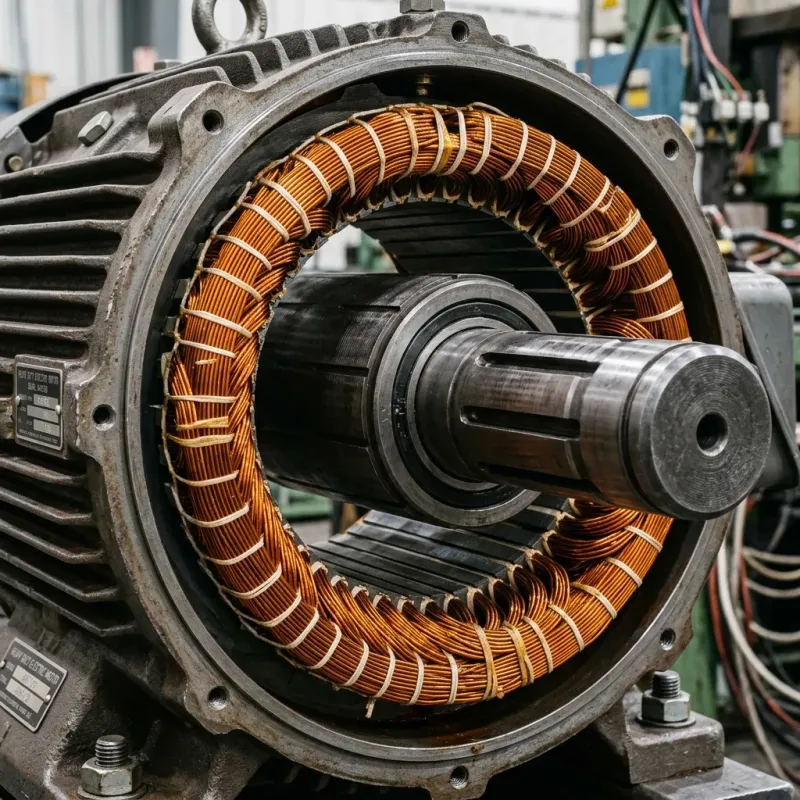
When a customer walks into our office asking for a submersible pump, one of the first questions we ask is simple but critical: "Do you have single-phase or three-phase power at your site?" The answer determines everything — the type of motor, the control panel, the cable sizing, and ultimately the performance and longevity of your entire pump installation.
Despite this critical role, the difference between single-phase and three-phase motors remains one of the most commonly misunderstood aspects of pump selection in India. This article provides a rigorous, plain-English breakdown of both motor types.
The Basics: What is an Electric Motor?
An electric motor converts electrical energy into mechanical (rotational) energy. In submersible pumps, this rotational energy spins the impellers that move water. The fundamental mechanism is electromagnetic induction — a rotating magnetic field created by the motor's windings induces current in the rotor, creating the torque that makes it spin.
How that rotating magnetic field is created determines whether you have a single-phase or three-phase motor.
Single-Phase Motors: How They Work
Power Supply: Single-phase power is what standard household electricity in India provides — 230 Volts, 50 Hz, delivered through two wires (one phase wire and one neutral).
The Problem: A single sinusoidal waveform cannot naturally create a rotating magnetic field. It creates a pulsating field — the magnetic force surges and collapses 100 times per second (twice per 50Hz cycle). On its own, this pulsating field cannot start rotation.
The Solution — Starting Mechanisms: Single-phase motors require auxiliary components to create an artificial phase shift that initiates rotation at startup:
Capacitor Start (CS): A start capacitor creates a phase-shifted current in an auxiliary winding during startup only. Once the motor reaches about 75% of rated speed, a centrifugal switch disconnects the start capacitor. Common in pumps up to 1 HP.
Capacitor Start, Capacitor Run (CSCR): Uses two capacitors — a larger one for starting and a smaller permanent-run capacitor for improved running efficiency. Most Indian single-phase submersible pump motors (up to 2 HP) use this design.
Permanent Split Capacitor (PSC): A single run capacitor permanently connected, with no centrifugal switch. Lower starting torque but quieter and more reliable. Used in smaller fractional-HP applications.
After Startup: Once the rotor is spinning, the single-phase supply maintains rotation adequately, though with more vibration and slightly lower efficiency than three-phase operation.
Three-Phase Motors: How They Work
Power Supply: Three-phase power — three sinusoidal waveforms, each offset by 120° from each other, delivered at 415 Volts, 50 Hz through three (or four, with neutral) wires. Available in industrial zones, farms in many states, and most commercial buildings with a three-phase connection.
The Natural Advantage: When three windings — each energized by one of the three phase wires — are arranged symmetrically inside a motor stator, they naturally create a smoothly rotating magnetic field. No auxiliary components are needed.
Self-Starting & Smooth Operation: The three-phase motor starts immediately when power is applied, with high torque. The three waveforms complement each other so that total power delivery is constant at every instant — unlike single-phase where power delivery drops to zero 100 times per second. This constant power delivery translates to smoother rotation, less vibration, and significantly reduced mechanical stress on bearings and impellers.
A Side-by-Side Technical Comparison
| Parameter | Single-Phase Motor | Three-Phase Motor |
|---|
| Supply Voltage (India) | 230V, 50 Hz | 415V, 50 Hz |
| Number of Wires | 2 (Phase + Neutral) | 3 or 4 (3 Phases + Neutral) |
| Self-Starting | ❌ No — needs capacitor/aux. winding | ✅ Yes — starts automatically |
| Rated Efficiency | 75–85% | 85–96% |
| Power per frame size | Lower — more material for same output | Higher — compact, lightweight design |
| Vibration | Higher (pulsating power delivery) | Lower (smooth, constant power) |
| Max Practical HP | Up to ~5 HP (typically limited to 2-3) | 0.5 HP to 500+ HP |
| Starting Torque | Low to moderate | High |
| Maintenance Points | Capacitor, switch (failure-prone) | Minimal — no capacitors or switches |
Pros and Cons for Pump Applications in India
Single-Phase Motors
Advantages:
- Universal availability: Single-phase power is available in every home, shop, and farm with a basic electricity connection. No special high-tension line required.
- Lower infrastructure cost: No need for three-phase metered connection, which can involve significant deposit and application costs in some states.
- Simple control panel: A basic single-phase auto-reset DOL starter costs ₹800–₹2,500. No complex switchgear needed.
- Sufficient for domestic needs: For a standard house drawing water from 100–200 foot depth with a 0.5 to 1.5 HP pump, single-phase is perfectly adequate.
Disadvantages:
- Limited power ceiling: Practically caps out at about 3–5 HP. Beyond this, single-phase motors become inefficient, oversized, and thermally stressed.
- Capacitor failures: The start capacitor is the most common failure point in single-phase submersible pump systems. A failed capacitor causes the motor to not start or to burn out quickly. In areas with frequent power cuts and restarts, capacitor life is markedly reduced.
- Higher electricity cost: Lower power factor (typically 0.65–0.75) means the electricity meter runs faster per unit of useful work done. Your electricity bill is higher relative to the water lifted.
- Voltage sensitivity: Single-phase motors are more vulnerable to voltage fluctuations — particularly to single-phasing during a three-phase supply disruption that leaves one phase live.
Three-Phase Motors
Advantages:
- High efficiency: Three-phase motors routinely achieve efficiencies of 88–95%, directly translating to lower electricity bills. For a pump running 6–8 hours per day, the energy saving over 5 years significantly exceeds any cost premium.
- No capacitors: Eliminates the most common failure point in single-phase systems. A well-maintained three-phase submersible motor has a dramatically longer operating life.
- High starting torque: Critical for deep borewells where the motor must start against the weight of a full column of water in the delivery pipe.
- Scalable to any power requirement: From 1 HP agricultural pumps to 50 HP industrial submersibles for municipal supply — all use three-phase motors.
- Better for heavy-duty and continuous operation: Hotels, factories, hospitals, and high-rise buildings running pumps 12–20 hours per day should always use three-phase motors. The thermal management is superior.
Disadvantages:
- Requires three-phase connection: Not available at all locations. Rural areas, older neighbourhoods, and domestic residential connections often have only single-phase supply.
- Higher panel cost: Three-phase control panels (DOL, Star-Delta, or VFD) are more expensive than their single-phase counterparts. A Star-Delta panel for a 10 HP motor starts at ₹8,000–₹15,000.
- Single-phasing danger: If one of the three supply phases fails (due to line fault or blown fuse), the motor continues to run on two phases, drawing excessive current and overheating. A phase-failure relay is mandatory in the control panel — adding to cost.
The most common cause of three-phase submersible motor burnout in India is single-phasing — one phase of the supply failing while the motor continues to attempt running. Always insist on a control panel with a built-in phase-failure relay. This is non-negotiable for any three-phase installation.
Which Should You Choose? The Decision Framework
Choose Single-Phase if:
- Your site has only a standard domestic electricity connection (common in residential plots)
- Your water requirement can be met by a pump up to 2–3 HP
- Borewell depth is under 150–200 feet with a moderate yield
- Budget for electrical infrastructure is limited
- Application is domestic — household water supply, small garden, modest farm
Choose Three-Phase if:
- Three-phase power is already available at your site
- You need a pump of 3 HP or above
- You are serving a commercial property, housing society, hotel, factory, or agricultural operation
- Borewell depth exceeds 200 feet (indicating harder geological formations and higher starting load)
- You need to run the pump for extended hours daily — energy efficiency becomes economically critical
- You want maximum motor life with minimum maintenance
A Practical Note for Farmers in Gujarat: Many agricultural connections in Gujarat are provided under PGVCL's agricultural tariff which supplies single-phase power during scheduled hours. Recently, many progressive farmers have opted for three-phase connections under Kisan Urja Suraksha Evam Utthaan Mahabhiyan (KUSUM) to install solar-powered three-phase pump systems — gaining both efficiency and energy independence.
The Role of the Control Panel
No discussion of single-phase vs. three-phase is complete without mentioning the control panel, which protects the motor and manages its starting and running behaviour:
For single-phase motors: A standard single-phase DOL (Direct-On-Line) starter or an auto-reset panel with overload protection, dry-run protection, and auto-restart is typical. For pumps above 1.5 HP, a capacitor start panel with thermal overload is standard.
For three-phase motors:
- DOL Starter: Suitable for small motors (up to 5–7.5 HP) — direct connection to grid, no current limiting at start. Simple and economical.
- Star-Delta Starter: For motors 7.5 HP and above — starts the motor "in star" (reduced voltage), then switches to "delta" (full voltage) once up to speed, limiting destructive in-rush current. Extends motor life considerably.
- VFD (Variable Frequency Drive): The premium choice for any application where flow needs to vary — pressure boosting systems, hydro-pneumatic sets. Controls speed electronically for maximum efficiency and near-elimination of mechanical starting stress.
Conclusion
The single-phase versus three-phase decision is not arbitrary — it flows logically from your available power supply, your pump's horsepower requirement, your daily operating hours, and your long-term energy cost expectations. In India, where electricity tariffs are rising and pump replacement is expensive, choosing the right motor type from day one is one of the most important infrastructure decisions a home owner, farmer, or facility manager can make.
At Xanausun, we supply L&T control panels, custom-configured DOL, Star-Delta, and VFD panels, and complete submersible pump systems for both single-phase and three-phase applications. Our Ahmedabad team can spec the right combination for your exact site conditions.