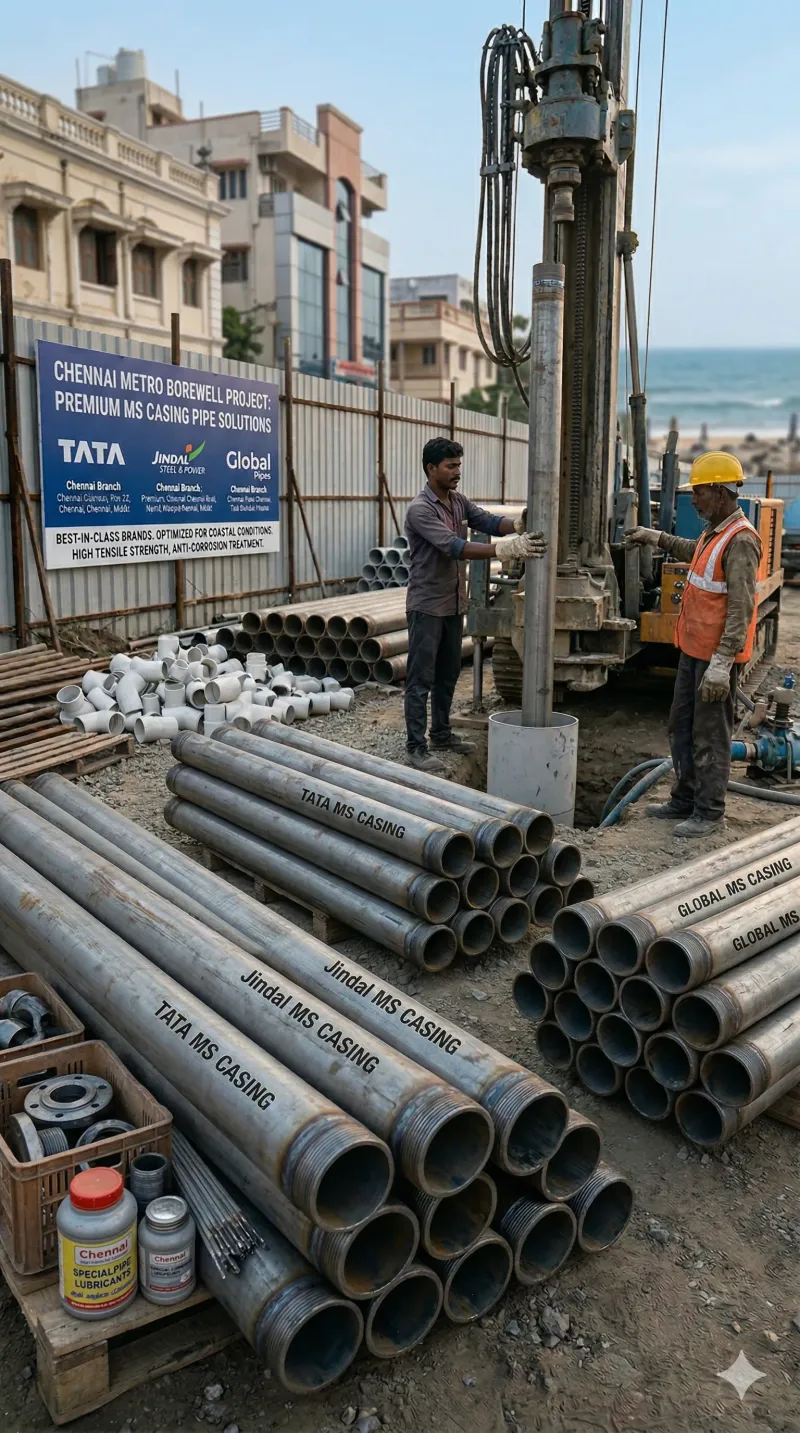
TATA MS Casing Pipes: The Structural Backbone of Heavy Industrial Borewells
Why mild steel casing from TATA remains irreplaceable for high-load, large-diameter borewell infrastructure — and how to spec it correctly for India's challenging geology.
Why mild steel casing from TATA remains irreplaceable for high-load, large-diameter borewell infrastructure — and how to spec it correctly for India's challenging geology.
When the geology demands it — fractured basalt, collapsing alluvial formations, or full-diameter requirements exceeding 10 inches — no polymer pipe can substitute for mild steel casing. TATA Steel's MS borewell casing remains the structural reference point for heavy industrial borewells across Gujarat, Maharashtra, and Rajasthan, and for good reason: it is the only material that simultaneously delivers column strength, lateral rigidity, and weldability at the scale large-diameter deep borewells demand.
At Xanausun, we specify TATA MS casing when borewell diameter exceeds 8 inches, depth exceeds 200 meters, pump HP is above 30, or when aquifer rock required blasting during drilling. Understanding the engineering rationale is essential for any infrastructure professional managing borewell assets.
"UPVC handles chemistry. MS handles geology. In unstable or hard-rock formations, no matter how good a polymer pipe's tensile rating is, lateral soil pressure will collapse it before the pump ever sees rated load."
TATA MS casing pipes for borewells are manufactured to BIS IS 4270. Within the MS classification, pipes are defined by wall thickness and yield strength:
| Grade | Wall Thickness | Yield Strength | Application |
|---|---|---|---|
| Light (LT) | 4.5mm | 245 MPa | Shallow borewells <60m, soft soil |
| Medium (MT) | 6.3mm | 310 MPa | 60–150m, mixed geology |
| Heavy (HT) | 8.0mm | 345 MPa | 150–300m, hard rock, high HP |
| Extra Heavy (XHT) | 10.0mm+ | 415 MPa | 300m+, blasted rock formations |
The primary concern with MS casing is corrosion. With correct surface treatment, service life reaches 25–30 years — competitive with polymer alternatives at large diameters.
Unlike UPVC, MS casing sections are joined by circumferential butt welding on-site. This eliminates joint-integrity concerns at depth but requires qualified welders, correct filler rod specification (ER70S-3 for structural grade MS), and post-weld inspection before the casing string is lowered. Where retrievability is required, TATA also manufactures ISO-standard taper-threaded MS casing for mechanical joint assembly without site welding.
In unconsolidated aquifer formations, the casing must transition into a slotted screen zone. TATA MS casing can be field-slotted using bridge-slot cutting machines or supplied pre-slotted. Slot dimensions must match the formation's D-50 particle diameter from sieve analysis — typically sized at 70% of D-50 to balance inflow and sand exclusion efficiency.