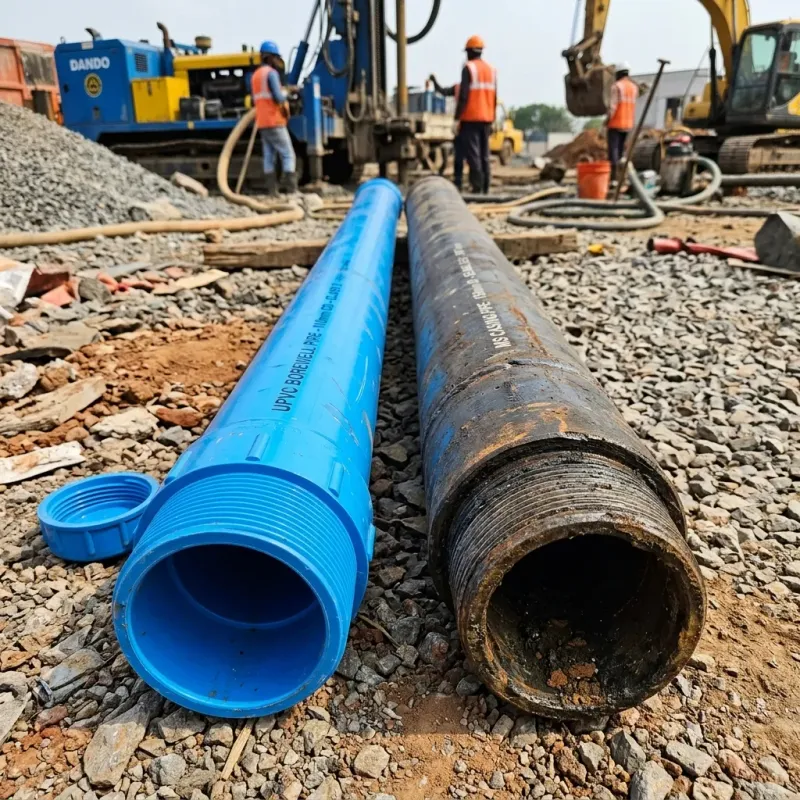
The casing pipe is the borewell's skeleton — the permanent lining that prevents the borehole walls from collapsing, keeps the water passage clean, and determines the long-term structural integrity of your entire groundwater extraction system. Unlike a pump, which can be pulled out and replaced, the casing pipe is installed once and stays underground for the life of the borewell.
Choosing the wrong casing material is an irreversible and expensive mistake. In India, three materials are in active use: UPVC (Unplasticized Polyvinyl Chloride), Mild Steel (MS), and Cement/Concrete. This guide compares all three across every parameter that matters for an Indian borewell.
Understanding the Role of Casing Pipes
Before comparing materials, it helps to understand the two distinct types of casing in a borewell:
1. Casing Pipes (Solid): Line the upper section of the borewell — typically from the surface down to the stable rock formation. Primary role is structural: prevent borehole wall collapse, block surface contaminants from entering the well, and provide a clean annular space for the submersible pump and column pipe assembly.
2. Slotted/Ribbed Screens (Perforated): Installed in the water-bearing zone. The perforations or ribbed slots allow water to enter from the surrounding formation into the borewell, while filtering out sand and gravel. Often called well screens, slotted casing, or ribbed screens.
Both types are available in UPVC, MS, and concrete — though concrete is rarely used for the screen section.
Option 1: UPVC Casing — The Modern Standard
Unplasticized PVC (distinct from flexible PVC — "U" means the compound is not plasticized, making it rigid and strong) has become the dominant choice for Indian borewells over the last two decades. Bureau of Indian Standards specification IS:12818 governs UPVC borewell casing in India.
How UPVC is Made
UPVC borewell casing is manufactured by extrusion — raw UPVC compound is pushed through a die at controlled temperature to form a uniform-walled tube. After extrusion, pipes are sleeved with a flush-joint or threaded coupling system. The material is then tested for impact resistance, pressure rating, and dimensional tolerance before receiving ISI certification.
UPVC Advantages
Corrosion Immunity: UPVC does not rust, corrode, or react with the minerals and chemicals commonly found in Indian groundwater — including high chloride content (coastal areas), high fluoride (many Gujarat districts), and slightly acidic or alkaline conditions. This is UPVC's single most important advantage. An MS pipe that begins corroding underground cannot be inspected or treated; it silently degrades until the casing fails.
Water Quality: UPVC does not leach metals, organic compounds, or taste-affecting substances into water. This is critical for borewells supplying drinking water. IS:12818-certified UPVC pipes have passed food-grade safety testing.
Hydraulic Efficiency: UPVC's smooth inner surface has a very low coefficient of friction (Manning's n ≈ 0.009), compared to slightly rougher MS (n ≈ 0.012 new, increasing with corrosion). For equivalent pipe sizes, UPVC delivers slightly more water per unit of pump energy — a marginal but real benefit.
Lightweight Logistics: A 6-metre section of 150mm (6-inch) UPVC casing weighs approximately 8–10 kg. The equivalent MS section weighs 30–40 kg. This dramatically reduces transport cost (lighter load per truck), and more importantly, allows manual handling during installation without cranes or heavy equipment.
Quick Installation: UPVC joints are threaded or flush-coupled — casing sections screw together by hand and seal tight. MS casing requires on-site welding by a skilled welder, adding labour cost, time, and the risk of poor welds that leak.
Cost-Effective: UPVC casing is typically 30–50% cheaper than MS casing for equivalent diameter and depth, when total procurement (material + labour + transport) costs are compared.
UPVC Disadvantages
Lower Impact Strength: While UPVC is strong in compression and resists internal water pressure excellently, it is less resistant to sudden point-impact loading than steel. In highly unstable, fractured rock formations where the borehole may shift during drilling, UPVC can crack.
Temperature Limitations: UPVC softens at elevated temperatures. This is not a concern for standard groundwater borewells where temperatures are constant at 18–25°C. Only geothermal or hot spring borewells would present a thermal concern.
Pressure Rating Limits: UPVC comes in classes — Class 4, Class 6, and Class 10, each rated for specific working pressures. For extremely deep borewells (300+ metres), ensuring Class 10 specification is critical. Using Class 6 at depths requiring Class 10 leads to pipe failure under hydrogeostatic pressure.
Option 2: MS (Mild Steel) Casing — The Traditional Heavy-Duty Option
Mild steel casing dominated Indian borewell drilling before UPVC became widely available and affordable. It is manufactured from IS:2062 grade mild steel plates formed into tubes and welded longitudinally. Wall thickness commonly ranges from 4.5 mm to 8 mm depending on diameter.
MS Casing Advantages
Extreme Structural Strength: Mild steel has a tensile strength of ~400 MPa and a yield strength of ~250 MPa. In highly unstable geological formations — loose alluvial river beds, collapsing laterite zones, or very unstable sandy formations — MS casing provides structural rigidity that no polymer pipe can match. If the borehole is in a zone subject to external soil pressure or shifting rock, MS holds.
Large Diameter Availability: UPVC commercially available borewell casing maxes at about 250–300mm (10–12 inches). For large-diameter borewells — dug wells converted to tube wells, industrial borewells requiring extremely high flow — MS is the only practical material.
Weld-in-Place Flexibility: MS sections can be custom-cut and welded to exact lengths in the field, useful for complex borewell designs with varying casing requirements at different depths.
MS Casing Disadvantages
Corrosion — The Fatal Flaw: Mild steel corrodes in the presence of water, oxygen, and dissolved minerals. Even with galvanizing (zinc coating), underground MS casing begins corroding within 5–15 years depending on the aggressiveness of the groundwater. Once corrosion begins in the screened section, rust particles contaminate the water supply. Eventually, corrosion perforates the casing wall, causing structural collapse inside the borewell and requiring expensive rehabilitation or complete re-drilling.
Water Quality Impact: Corroding MS casing introduces iron and heavy metals into the water. This raises TDS, imparts metallic taste, and can render water unsuitable for drinking or industrial processes without expensive treatment.
High Cost: MS casing material costs more per metre than UPVC. Additionally, transport of heavy steel sections is expensive, on-site welding adds significant labour cost, and future maintenance costs (if attempted) are much higher.
Difficult Installation: Welding MS casing sections inside a narrow borehole requires skilled welders with proper equipment. Poor welds that fail inspection are common on tight-budget projects.
Option 3: Cement/Concrete Casing — The Traditional Shallow-Well Option
Cement-concrete rings are pre-cast cylindrical sections used almost exclusively for large-diameter, shallow open wells (dugwells) — typically 1 to 2 metres in diameter and 15–30 metres deep — rather than narrow-bore tube wells.
Concrete Casing Advantages
Structural Compression Resistance: Concrete is extremely strong in compression. For an open well with loose, sandy soil walls that would collapse without support, concrete rings provide excellent lateral structural support.
Chemical Inertness: Concrete does not rust and is largely chemically inert to normal groundwater minerals.
Low Material Cost: Raw concrete is inexpensive. Pre-cast rings are cost-effective for shallow dug wells where the diameter is large.
Concrete Casing Disadvantages
Not Suitable for Tube Wells: Concrete rings cannot be used in narrow-bore submersible borewells. The internal diameter required to accommodate a 4-inch or 6-inch submersible pump means a concrete casing would need to be enormous. The weight of concrete rings makes drilling-while-casing (the standard method for narrow tube wells) physically impossible.
Porous Over Time: Cement is a porous material. Without proper sealing, groundwater gradually seeps through the walls. In polluted urban environments, surface water contamination can bypass a poorly sealed concrete well wall.
Labour-Intensive: Installing concrete rings in a newly drilled hole requires heavy equipment (cranes or tripod hoists) for lowering each ring. Not practical in confined spaces.
Head-to-Head Comparison Table
| Parameter | UPVC | MS (Mild Steel) | Cement/Concrete |
|---|
| Corrosion Resistance | ✅ Excellent — fully immune | ❌ Poor — corrodes in 5–15 years | ✅ Good — does not rust |
| Water Quality Safety | ✅ Excellent — food-grade safe | ⚠️ Degrades — iron contamination | ✅ Good |
| Structural Strength | ✅ Good (standard formations) | ✅ Excellent (unstable formations) | ✅ Excellent (compressive) |
| Weight | ✅ Very light | ❌ Heavy | ❌ Very heavy |
| Installation Ease | ✅ Threaded, manual assembly | ❌ Requires welding | ❌ Requires heavy equipment |
| Cost (Total) | ✅ Low — 30–50% cheaper | ❌ High | ⚠️ Low material, high logistics |
| Suitable for Tube Wells | ✅ Yes | ✅ Yes (large diameter) | ❌ No — not practical |
| Long-Term Life | 30–50 years | 10–25 years | 20–50 years |
The Definitive Recommendation
For 95% of Indian borewells — residential, agricultural, and commercial tube wells — ISI-certified UPVC casing is the correct choice. It is cheaper, corrosion-proof, water-safe, lightweight, and quick to install. UPVC has replaced MS casing in the mainstream market for excellent, well-founded reasons.
When to specify MS casing:
- Geological report indicates highly unstable, collapsing formations that UPVC cannot safely withstand
- Borehole diameter requirements exceed what UPVC can provide commercially
- Very high-pressure applications where Class 10 UPVC is nonetheless insufficient (rare in standard borewells)
When to specify Concrete:
- Large-diameter shallow dug wells and step wells
- Ring wells in rural domestic applications
Never compromise on UPVC casing pipe quality. Insist on IS:12818-stamped, ISI-certified pipes from established manufacturers. Unbranded or substandard casing pipes sold at a discount often have inconsistent wall thickness, inferior raw material, and no quality testing — they can collapse underground under external pressure, destroying a borewell that cost ₹2–5 lakhs to drill.
Practical Guidance: What to Specify for a Borewell in Ahmedabad and Gujarat
The geology of Ahmedabad and central Gujarat consists predominantly of alluvial formations in the upper layers (0–60 metres) transitioning to hard basalt and deccan trap formations at depth. The alluvial upper zone requires strong casing to prevent collapse during drilling. For most projects in this region:
- 0 to 10 metres (surface zone): 6-inch UPVC Class 6 solid casing with surface-seal grouting to prevent surface contamination
- 10 to 60 metres (alluvial formation): 6-inch UPVC Class 6 or Class 10 solid casing (depends on water level)
- 60 metres and below (hard rock zone): Borehole is typically open (no casing needed in competent rock) or fitted with 4-inch UPVC slotted screen in water-bearing fracture zones
For deeper borewells (150–300 metres) or high-yield commercial borewells serving housing societies or industrial applications:
- Use 6-inch UPVC Class 10 throughout the required casing depth
- Specify Astral or other ISI-certified brand
- Use UPVC ribbed screens in the water-bearing zones for filtration of fine sand
Conclusion
The materials available for borewell casing each have their place — but in the context of modern Indian groundwater extraction through narrow-bore submersible borewells, UPVC is the unambiguous correct choice for the vast majority of applications. It offers superior longevity, cleaner water, simpler installation, and lower total cost of ownership than the alternatives.
At Xanausun, we supply ISI-certified Astral UPVC casing pipes and ribbed screens in 4-inch, 5-inch, and 6-inch nominal diameters, in Class 4, Class 6, and Class 10 pressure ratings, along with TATA MS casing for the rare applications that genuinely require it. Our team can help you determine the right specification for your borewell geology and depth.