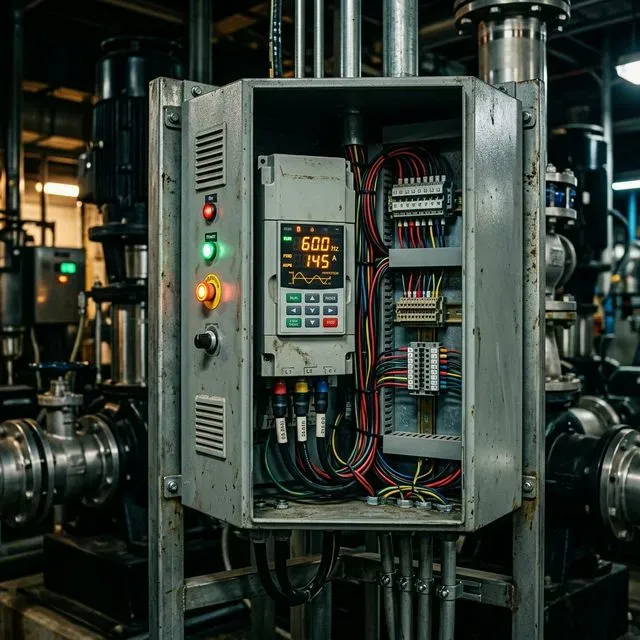
Historically, starting a massive industrial submersible pump was a brutal process. An operator would flip a switch, and the motor would violently draw a massive surge of electricity—often up to 600% of its normal operating current—to go from zero to maximum RPM instantly. This violent start created immense mechanical stress, shattered pipes through "water hammer," and spiked utility bills.
Enter the Variable Frequency Drive (VFD) Control Panel.
VFDs have fundamentally fundamentally transformed modern water extraction strategy. Whether you are managing an agricultural irrigation network or an industrial pumping station in Ahmedabad, a VFD panel shifts your system from a blunt instrument into a precision-engineered smart system. Let's explore exactly what they are and why they are now a mandatory integration.
How a VFD Control Panel Works
A basic control panel operates as a binary switch: the pump is either 100% ON or 100% OFF.
A Variable Frequency Drive, however, acts as the "brain," actively manipulating the frequency and voltage of the electrical power supplied to the submersible motor. By altering the Hz (frequency), the VFD dictates the precise RPM (Revolutions Per Minute) of the pump's impeller.
If your pressure drops slowly, the VFD tells the pump to spin up slowly to match the exact required flow rate. If no water is being demanded, it gracefully powers down.
The 4 Core Advantages of VFDs in Water Pumping
1. The "Soft Start" & "Soft Stop"
By far the most critical function of a VFD is its ability to slowly ramp up power.
- Mechanical Immunity: Eliminating the violent torque of standard starts extends the lifespan of the motor's bearings and structural mounts.
- Zero Water Hammer: Sudden pressure spikes created when a pump slams water through empty pipes can literally shatter UPVC and even steel joints. A VFD starts the flow gently, allowing the pipeline to pressurize safely.
2. Radical Energy Efficiency
Power consumption in centrifugal pumps follows affinity laws—meaning a small reduction in motor speed yields a disproportionately massive reduction in energy use. Reducing a pump's speed by just 20% can cut your electrical consumption by nearly 50%. Since VFDs only run the pump as fast as mathematically required to meet real-time demand, the ROI in electricity savings often pays for the VFD panel within 12 to 18 months.
3. Total Motor Protection Protocols
Advanced VFD panels aren't just speed controllers; they are diagnostic fortresses. A premium VFD panel will automatically sever power in milliseconds before catastrophic damage occurs during:
- Dry Running: If groundwater levels drop below the pump, the VFD detects the altered load and cuts power, preventing the motor from melting down in an empty borewell.
- Over-Voltage / Under-Voltage: Indian power grids can be volatile. The VFD acts as a buffer.
- Phase Loss or Imbalance.
4. Constant Pressure Maintenance
When paired with an external pressure transducer, the VFD creates a closed-loop feedback system. If someone opens a single tap, the pump spins at 15%. If ten industrial valves open simultaneously, the VFD instantly detects the pressure drop and spins the pump up to 90% capacity to maintain perfectly flat, consistent pressure across the entire facility.
Is a VFD Panel Worth the Cost?
For residential borewells using very low horsepower pumps (1HP - 2HP), a traditional Direct-On-Line (DOL) or standard starter panel with basic dry-run protection is usually sufficient.
However, for commercial, agricultural, and industrial tier pumps (5HP and above), running without a VFD is financial self-sabotage. The upfront premium spent on a VFD panel is eclipsed by the protection it provides against burnt out motors, burst pipes, and compounding electrical bills.
At Xanausun, we engineer and integrate bespoke VFD control panels perfectly calibrated to your primary pumping infrastructure. Because an efficient pump is irrelevant if its brain is obsolete.