What is a Percolation Borewell? Purpose, Process & Why India Needs It
A comprehensive guide to percolation borewells in the Indian context — what they are, how they work, how they differ from extraction borewells, and who needs one.
A comprehensive guide to percolation borewells in the Indian context — what they are, how they work, how they differ from extraction borewells, and who needs one.
India is staring at a groundwater crisis. According to the Central Ground Water Board (CGWB), a significant portion of India's assessed groundwater blocks are now classified as "over-exploited" or "critical." In states like Gujarat, Rajasthan, Haryana, and parts of Tamil Nadu, borewells that yielded abundant water just 10–15 years ago now run dry during peak summer months.
The percolation borewell — also called a recharge borewell or injection well — is one of the most practical and under-utilized solutions to this problem. In this article, we explain what it is, how it works, and why it is increasingly becoming a regulatory requirement for large residential and commercial projects across India.
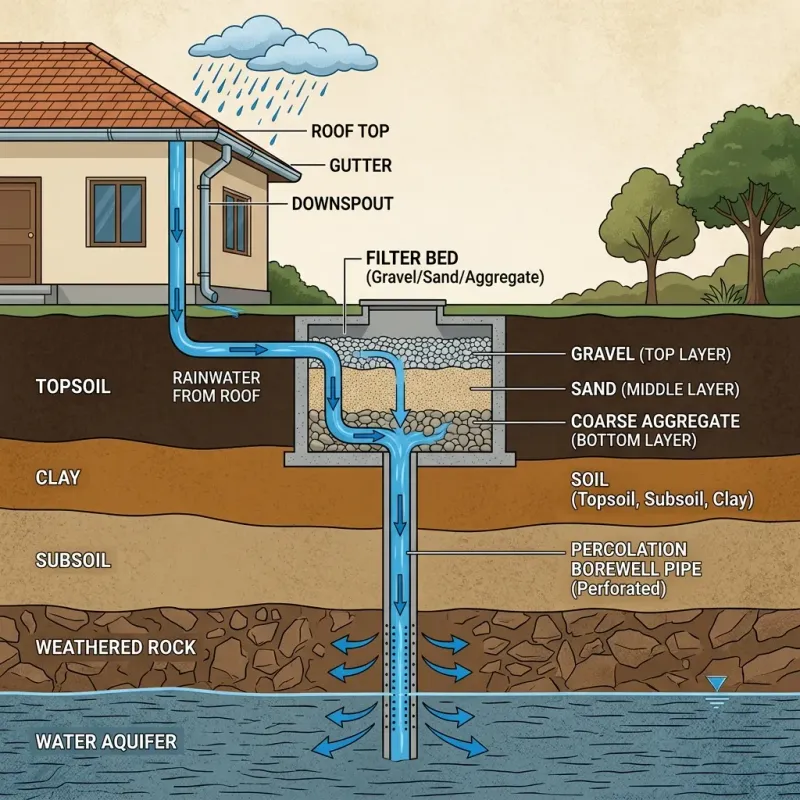
A percolation borewell is an artificial groundwater recharge structure designed to direct surface water — typically harvested rainwater — deep into underground aquifers, replenishing them naturally.
Unlike a conventional extraction borewell, which pumps water out of the ground for use, a percolation borewell works in the opposite direction: it routes water into the ground during and after rainfall events, allowing it to percolate through soil and rock strata until it reaches the water-bearing aquifer below.
Think of it as a reverse borewell. You are not extracting — you are depositing.
Urban India has a paradoxical problem: during monsoon, rainwater floods streets and creates waterlogging; during summer, groundwater levels plunge. The reason is concrete.
As cities expand, natural soil surfaces are replaced by concrete, asphalt, and paving. Rainwater that would naturally soak into the ground is now redirected to stormwater drains and eventually discharged into rivers or the sea — unused. This breaks the natural recharge cycle of aquifers. Percolation borewells restore this cycle artificially.
In a natural, undisturbed landscape, up to 40–50% of rainfall infiltrates into the ground and recharges aquifers. In a fully concreted urban plot, this figure drops to near zero.
The process begins with a well-designed rainwater harvesting system on the property. For residential buildings, this typically means rooftop gutters and drainpipes that route water to a central collection sump rather than letting it run off into the street.
Collected rainwater must be filtered before being directed into the ground. Without filtration, organic debris, silt, and pollutants would enter the borewell and eventually clog the aquifer formation. The standard filtration sequence is:
The filter unit is typically a concrete chamber or a PVC pipe column filled with alternating layers of coarse gravel, medium gravel, and washed sand.
The filtered water flows from the filter sump into the percolation borewell. A standard percolation borewell in urban India is typically:
The water enters at the top and percolates downward through the geological strata, gradually recharging the aquifer over hours or days after the rainfall event.
Once the water reaches the aquifer, it joins the regional groundwater body. From here, it can be extracted again through neighbouring borewells — including your own extraction borewell — weeks or months later.
There are two main approaches used in Indian practice:
Direct Recharge (Borewell-to-Aquifer Injection) In this method, filtered rainwater is injected directly into an existing borewell — sometimes an old, dried-up borewell is repurposed as a recharge structure. This is the most efficient method when done correctly, but requires the borewell to be clean and the aquifer to be receptive. It is common in urban plots where land is scarce.
Indirect Recharge (Percolation Pit or Recharge Well) A separate recharge pit or well is constructed near the main extraction borewell (typically 3–5 metres away). The pit is filled with gravel and sand layers and allows water to naturally percolate into the surrounding soil, which eventually reaches the aquifer. This method is gentler on the aquifer and is often recommended for new construction projects.
By Regulation (Mandatory in Many States)
Several Indian state governments and urban development authorities have made rainwater harvesting and groundwater recharge mandatory:
By Practical Need
| Feature | Extraction Borewell | Percolation Borewell |
|---|---|---|
| Direction of water flow | Ground → Surface (pumped up) | Surface → Ground (injected in) |
| Pump required? | Yes — submersible pump | No — gravity-fed |
| Casing type | Solid UPVC / MS casing | Perforated/slotted UPVC in lower sections |
| Operates during | On-demand (year-round) | During and after rainfall events |
| Regulation | Water extraction permits may apply | Mandatory for large buildings in many states |
| Purpose | Water supply | Aquifer replenishment |
A helpful rule of thumb used by groundwater engineers in Gujarat:
A qualified hydrogeologist or experienced borewell contractor should assess the local geology before deciding on the number, depth, and type of recharge structure.
Important: A percolation borewell that receives unfiltered rainwater — especially runoff from roads or chemically treated surfaces — will eventually choke the aquifer formation with silt. Filtration is not optional; it is the most critical component of a functional recharge system.
A correctly designed percolation system means your property recharges more water into the ground than it extracts — making it water-positive over the full monsoon-to-summer hydrological cycle. This:
The percolation borewell is not a luxury engineering intervention reserved for large infrastructure projects. It is a practical, cost-effective, and often legally required component of responsible groundwater management for any property with a borewell in India. As water tables continue their long-term decline across Gujarat and other water-stressed states, investing in recharge infrastructure is investing in the long-term usability of your most critical water asset.
At Xanausun, we supply the UPVC slotted casing pipes, gravel packing materials, and filtration components required for complete percolation borewell systems. Contact our Ahmedabad team for specifications and availability.