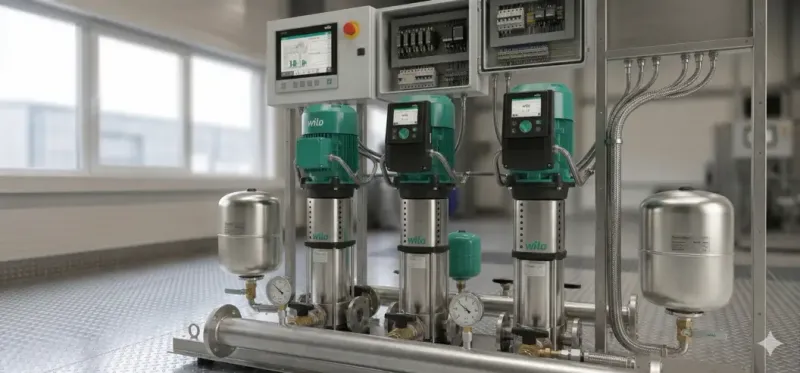
As industrial facilities increasingly demand constant-pressure water delivery across variable-demand profiles — from near-zero flow during night-time standby to full peak load during production shifts — the traditional on/off pump-with-pressure-tank model has become structurally obsolete. Wilo's hydro-pneumatic pressure management systems represent a fundamental rethinking of how industrial water pressure is stored, managed, and delivered — and their integration with variable speed drives (VSD) makes them the most energy-efficient solution available for large-scale pressure booster applications.
At Xanausun, we supply Wilo hydro-pneumatic systems for pharmaceutical cleanrooms, large residential complexes, commercial towers in GIFT City, and other high-demand installations across Ahmedabad and the surrounding region. The engineering principles behind correct system sizing are non-trivial — and incorrect sizing remains the primary cause of premature bladder failure and chronic pressure fluctuation.
"A hydro-pneumatic tank doesn't just buffer pressure — it eliminates the hydraulic shock that kills pump seals, reduces motor starts-per-hour by 85%, and enables variable speed drives to run at peak efficiency across the entire demand curve."
How Hydro-Pneumatic Systems Work: The Core Principle
A hydro-pneumatic system uses a sealed pressure vessel containing both water and a compressible gas (typically nitrogen) separated by a flexible bladder. As the pump fills the vessel, the gas compresses; when demand draws water, the compressed gas expands and pushes water out — maintaining pressure without the pump needing to run continuously. This dramatically reduces pump wear, energy consumption, and pressure fluctuations in the system.
System Architecture: The Four Components
- Pre-charged bladder vessel: Steel shell with polymer bladder, factory pre-charged to 70% of system operating pressure. Vessel volume must be sized to limit pump start frequency to below 10 starts/hour at minimum demand flow. Wilo vessels range from 8L to 5,000L.
- Wilo VSD pump unit: The primary driver — a centrifugal pump coupled to a permanent magnet EC motor with integrated variable speed drive. The EC motor operates between 20–100% speed, modulating output to match instantaneous demand. At 50% flow demand, power consumption drops to approximately 12.5% of rated — not 50%, due to the cube law relationship between pump speed and power.
- Pressure transducer and PID controller: A 4–20mA pressure transducer at the system outlet feeds a closed-loop PID controller embedded in the Wilo drive. The controller calculates the speed command every 250ms, maintaining outlet pressure within ±0.1 bar of setpoint across all flow rates.
- Multi-pump cascade controller: For large facilities, Wilo's series allows up to 4 pump units to operate in parallel under single-controller sequencing. As demand rises, pumps are staged on one at a time — each running at variable speed for smooth output modulation. Conversely, as demand falls, pump units are staged off in reverse, with the last unit running at its lowest stable speed.
Sizing the Pneumatic Vessel: The Key Calculation
The vessel volume is determined by the Boyle's Law expansion ratio between pre-charge pressure, minimum operating pressure (cut-in), and maximum operating pressure (cut-out). For a typical commercial application with 4 bar cut-in, 6 bar cut-out, and nitrogen pre-charge at 3.6 bar:
| Parameter | Value | Notes |
|---|
| Pre-charge pressure (P0) | 3.6 bar | 90% of cut-in pressure |
| Cut-in pressure (P1) | 4.0 bar | Pump starts below this |
| Cut-out pressure (P2) | 6.0 bar | Pump stops above this |
| Usable volume ratio | 33% | From Boyle's Law |
| Required vessel (200 LPM flow) | ~500L | For <10 starts/hour |
Energy Savings: The Business Case
For a commercial facility consuming 800 LPM at peak with an 18-hour demand cycle, replacing a fixed-speed pump-and-tank system with a Wilo VSD hydro-pneumatic system typically delivers 35–45% reduction in pump energy consumption annually. At ₹8/kWh (commercial tariff), a 15HP system operating 18 hours/day for 330 days yields an annual saving of approximately ₹1.8–2.4 lakh — with equipment payback typically achieved in 24–36 months.
CONSULTATIONREADY TO UPGRADE TO CONSTANT-PRESSURE SYSTEMS?
ENQUIRE NOW