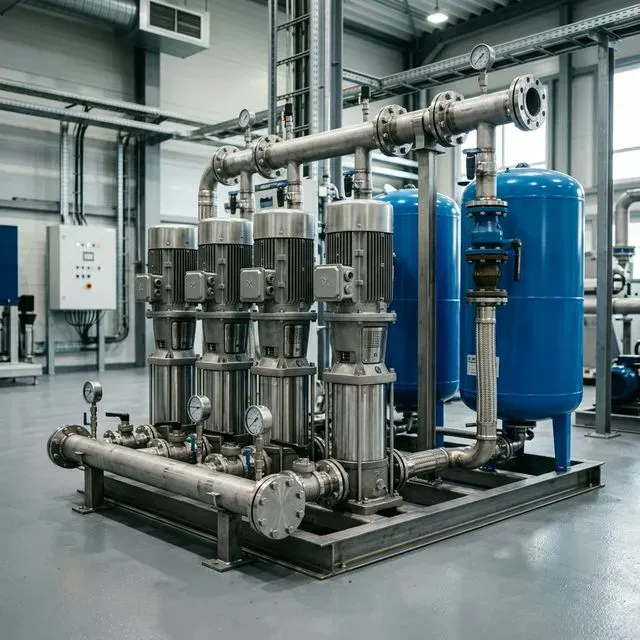
High-rise residential towers, sprawling luxury resorts, and complex pharmaceutical plants all share one critical requirement: water pressure must remain absolutely perfectly constant, regardless of how many taps, showers, or industrial valves are opened simultaneously.
To achieve this, engineers rely on Hydro-Pneumatic (HYPN) Pressure Boosting Systems. These systems combine multiple vertical multistage centrifugal pumps, Variable Frequency Drives (VFDs), and pressurized diaphragm tanks into one intelligent skid.
When it comes to HYPN systems, two European titans dominate the global premium market: Grundfos (Denmark) and Wilo (Germany). Both represent the absolute pinnacle of fluid engineering. However, their systems have distinct philosophical differences in design, software, and total cost of ownership (TCO). Let's compare them.
The Grundfos Hydro MPC Series: The Silicon Valley of Pumps
Grundfos practically invented the modern intelligent pressure booster. Their flagship Hydro MPC systems are renowned for their incredible software integration.
Why Choose Grundfos?
- The CU 352 Controller: Grundfos's proprietary controller is legendary. It is effectively a highly specialized industrial computer that anticipates pressure drops before they physically manifest in the pipeline, pre-spinning cascade pumps with frightening accuracy.
- IE5 Motors (MGE): Grundfos manufactures their own ultra-premium efficiency motors integrated directly with their VFDs. The energy savings on a large Grundfos system operating 24/7 are mathematically unmatched by almost any competitor.
- Plug-and-Play Ecosystem: If your facility utilizes BMS (Building Management Systems) via Modbus, BACnet, or LON, Grundfos systems integrate with absolute zero friction.
The Drawback
- The Price Premium: Grundfos is the absolute most expensive option on the market. Furthermore, because their motors and drives are highly proprietary proprietary, replacing a damaged VFD outside of warranty must be done through Grundfos, which carries a steep replacement cost.
The Wilo COR/SiBoost Series: German Brutalism
Wilo takes a slightly different approach. While they possess excellent software (their Smart Controller SCE is brilliant), Wilo’s systems are famous for their sheer mechanical resilience and heavily modular design.
Why Choose Wilo?
- Mechanical Indestructibility: Wilo's Helix series multistage pumps (the heart of their HYPN skids) are constructed with thicker gauge 304/316L stainless steel. If your incoming water supply has higher suspended solids or is mechanically abrasive, Wilo's hydraulics often withstand the punishment longer.
- Open-Architecture VFDs: Unlike Grundfos's proprietary locked-in electronics, Wilo frequently utilizes standardized, premium third-party VFDs (like Danfoss) mounted either on the motor or in the control panel. If a drive fails 10 years down the line, an industrial electrician can often wire in a commercially available replacement drive without being forced to buy an expensive proprietary spare part.
- Aggressive ROI: Wilo HYPN systems generally cost 10% to 15% less upfront than an identically spec'd Grundfos system, dramatically shortening the Return on Investment period for large real estate developers.
The Drawback
- Software Ecosystem: While Wilo's controllers are fantastic and fully capable of BMS integration, their UI and proactive cascade algorithms are very slightly less refined than the industry-leading Grundfos CU 352.
The Xanausun Verdict
If you are building an ultra-luxury hospital, a data center cooling loop, or an extreme high-rise where money is no object and software perfection is demanded—Grundfos is the gold standard.
If you are a commercial developer building a premium residential complex or industrial plant where extreme mechanical durability, open-architecture repairability, and strong financial ROI are your primary metrics—Wilo is arguably the smarter engineering choice.
At Xanausun, our HYPN team has overseen the installation of both platforms across Ahmedabad's skyline. Both are extraordinary. Your choice ultimately depends on whether you prioritize proprietary intelligence (Grundfos) or rugged modularity (Wilo).